 What can you say about a Michael Connelly novel that hasn't already been written before? Good question. But I'll give it a try. Echo Park is the 12th book in the Harry Bosch series (and his 17th work of fiction) and like a lot of people, I've read them all. Unlike a lot of people, I stop reading a popular series when the author gets a big head or his main character becomes an unbelievable super hero -- Tom Clancy and Jack Ryan, raise your hand. I also stop reading when the Hollywood ending is 10 times better than the book's ending -- John Grisham, you lost me at The Firm. Bosch, meanwhile, is the same crime-fighting bastard he's always been. And Connelly still refuses to sell Hollywood the rights to his famous character based in Hollywood. And, of course, he keeps pumping out quality stuff. In Echo Park, Connelly starts with a flashback to a case Harry and Jerry Edgar worked in 1993, one that still haunts Bosch 13 years later. And it's Bosch's pig-headed persistence that puts things into motion in this story. In addition to the cameo by Edgar -- and the far-too-coincidental introduction of his cousin, Gary -- reporter Keisha Russell and long-time nemesis Irving Irving make appearances. Connelly obviously enjoys having Bosch interact with a top-notch Los Angeles Times crime reporter, which he himself once was. The mention of Irving, meanwhile, reminds me of how Connelly has grown as a writer. In one early book, Connelly described Irving in cartoon character-like form -- as a buffoon who clenched his jaws and golf balls formed. That character is now a strong, very serious nemesis to Bosch, just as Connelly is a strong, very serious player in the crime fiction arena. (More Michael Connelly books and reviews)
Sunday, April 6, 2008
Michael Connelly 17: Echo Park
What can you say about a Michael Connelly novel that hasn't already been written before? Good question. But I'll give it a try. Echo Park is the 12th book in the Harry Bosch series (and his 17th work of fiction) and like a lot of people, I've read them all. Unlike a lot of people, I stop reading a popular series when the author gets a big head or his main character becomes an unbelievable super hero -- Tom Clancy and Jack Ryan, raise your hand. I also stop reading when the Hollywood ending is 10 times better than the book's ending -- John Grisham, you lost me at The Firm. Bosch, meanwhile, is the same crime-fighting bastard he's always been. And Connelly still refuses to sell Hollywood the rights to his famous character based in Hollywood. And, of course, he keeps pumping out quality stuff. In Echo Park, Connelly starts with a flashback to a case Harry and Jerry Edgar worked in 1993, one that still haunts Bosch 13 years later. And it's Bosch's pig-headed persistence that puts things into motion in this story. In addition to the cameo by Edgar -- and the far-too-coincidental introduction of his cousin, Gary -- reporter Keisha Russell and long-time nemesis Irving Irving make appearances. Connelly obviously enjoys having Bosch interact with a top-notch Los Angeles Times crime reporter, which he himself once was. The mention of Irving, meanwhile, reminds me of how Connelly has grown as a writer. In one early book, Connelly described Irving in cartoon character-like form -- as a buffoon who clenched his jaws and golf balls formed. That character is now a strong, very serious nemesis to Bosch, just as Connelly is a strong, very serious player in the crime fiction arena. (More Michael Connelly books and reviews)

Kyle Mills 4: Burn Factor
 I really liked the first three novels by Kyle Mills -- featuring brilliant but irreverent FBI agent Mark Beamon -- and I was a bit disappointed when Mills changed gears in Burn Factor and introduced female FBI computer programmer/agent-wannabe Quinn Barry. But as the book progressed, I became more and more into Barry, not to mention another great criminal fiction plot by Beamon. The book also features reclusive, former child genius Eric Twain who carries a good deal baggage -- both emotional and otherwise. And while the brain power shared between Barry and Twain is immense, Mills finds a way to portray them not as nerds, but attractive, relatively normal characters who are simply very damn smart. And my reward for accepting Barry? Beamon makes a cameo appearance in the book. Could this mean a book with both of them in it, or is it simply back to Beamon series for Mills? (Read more about Burn Factor on Amazon)
Wednesday, January 30, 2008
Olen Steinhauer 1: The Bridge of Sighs
 Set in an anonymous Eastern European country a few years after the end of World War II, The Bridge of Sighs is the debut of novelist Olen Steinhauer, who chronicles the first case of 22-year-old rookie detective Emil Brod. At first, the use of a fictitious country seems a bit strange to someone like myself who has been to Eastern Europe but, admittedly, is not an expert in the geography of that region. (Steinhauer wrote this book while on a Fullbright Fellowship in Romania and that country obviously gave him inspiration.) However, when you think about it, the use of a fictional country is a smart move in that it allowed the first-time novelist to concentrate on his story, rather than the endless research needed to properly document the political and culture history of a real country. Instead, Steinhauer's creation is a melting pot of characters from several different countries who interact with Brod during his murder investigation. Brod grows as both a man and detective during this story. And he slowly earns the admiration of his colleagues, even the mysterious Brano Sev, a state security officer attached to the homicide unit. Just like Brod on his first case, Steinhauer shines in his debut. The Bridge of Sighs is a trip worth taking, especially if you like European and war history, as well as detective fiction -- together in one book. (Read more about The Bridge of Sighs on Amazon)
Thursday, January 17, 2008
Ken Bruen 4: The Guards
 Just like beer, Ken Bruen is an acquired taste. My first exposure to Bruen was in The White Trilogy, which featured British detective Brant in three novels: A White Arrest; Taming the Alien; and The McDead. While The Guards was written before The McDead -- and Bruen has written a couple of prior books -- for my purposes, I consider this his fourth book. Anyway, Irish detective Jack Taylor is the focus of this book. A former member of the Irish Guards militia, Taylor takes shit the entire book since there aren't really any private eyes in Ireland. He also has major issues with alcohol and hangs around with some shady characters, which is your standard detective fare. What isn't standard, is the prose of Bruen. Not only are you hit with the Queen's English, but Bruen has a unique writing style in which he sometimes uses poetry. In the middle of a paragraph. Or he makes a list and puts it in the form of poetry. Similar to your first sip of beer, at the start of the novel, you are a little skeptical. But as you continue to read, it starts to make sense. And you find yourself enjoying his quirky style. Not to mention his characters. Bruen is compared to Dennis Lehane and George Pelecanos for this reason. Taylor and his criminal friend, Sutton, are both a dichotomy between good and bad, normal and abnormal. And just like Pelecanos, Bruen is a mix between detective fiction and book noir. A literary cocktail worth trying. (Ken Bruen books and reviews)
Sunday, December 30, 2007
Lee Child 3: Tripwire
 When you pick up a Lee Child novel, you know what you're getting. Mystery and some violence to go along with your mystery. In Tripwire, the third installment of the Jack Reacher series, the hero is in Key West hanging out, digging ditches and working as a bouncer in a strip club. In typical Reacher fashion, he vastly enjoys this drifter lifestyle. Soon, his peaceful existence is interrupted when he is sought out by a private detective and a couple of tough guys. Reacher winds up in New York City, where he reacquaints himself with the daughter of his mentor in the military police. And they unearth a plot that involves the military and MIA soldiers in Vietnam. (The movie Basic, with John Travolta and Samuel L. Jackson, has some very similar -- almost identical -- plot elements and if screenwriter James Vanderbilt didn't read this book, I'd be very surprised.) Reacher has an uncanny way of finding trouble, and by this third installment, the reader is hip to the modus operandi in this series -- the drifter is minding is own business until some criminal makes the mistake of awakening the sleeping giant, so to speak. Despite the predicitibility of the violence, this book -- and the two previous novels -- are entertaining in a Rambo meets Die Hard sort of way. And when I'm in the mood for more of this molotov cocktail style of writing, I'll pick up the next Jack Reacher novel. (Lee Child books and reviews)
Thursday, December 27, 2007
Boris Starling 3: Vodka
 I really enjoyed the first two books written by Boris Starling -- Messiah and Storm -- and I was expecting more of the same in Vodka, especially after one of the reviewers compared Starling to Martin Cruz Smith, obviously since the spectacular crime novel Gorky Park was also set in Moscow. However, for the first 300 pages of Vodka, crime took a backseat to an unlikely romance between American banker Alice Liddell and Russian mafia kingpin -- and politician -- Lev (no last name given). Somehow, the beautiful Liddell falls for the nearly seven foot tall tattooed not very handsome member of the Russian vory. In addition to the romance, the story also focuses on the Russian economy following the end of communism as Liddell is hired to privatize Lev's Vodka distillery, Red October. The book dragged for me for those 300 pages and I considered not finishing it. However, after several attempts, I finally continued -- and finished -- the book and I'm glad I did. Things pick up in the last 300 pages as crime takes front seat to finance as Estonian detective Juku Irk tracks the killer of several young orphans. If you like reading about business and the economy, this book will explain those concepts from the Russian perspective, where the black market under communism may have given them a better understanding of capitalism than those of us who have lived under it for our entire lives. If you like vodka, this book is a guide to the myriad different types and flavors of the drink that is the fabric of Russia. And finally, if you love crime -- and especially international crime -- this book provides a glimpse into the struggles of fighting crime in a country where the police receive little or no equipment, resources or pay. Things are even worse for Irk, who is not considered a Russian by most of those he meets. Hopefully, Starling will revive the Irk character in a future novel, similar to Arkady Renko appearing in a subsequent Smith novel. (Read more about Vodka on Amazon)
Saturday, December 22, 2007
John Shannon 1: The Concrete River
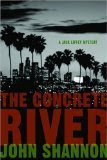 In The Concrete River, author John Shannon introduces us to an atypical gumshoe, who specializes in finding missing children. In typical detective fashion, Jack Liffey is divorced, has a child and is behind on his child support payments. He is also a Vietnam vet, who had a real job before his current gig. Set in Los Angeles, the grandmother of one of the children Jack found several years earlier asks him to look into the disappearance of the child's mother. When the woman is found dead, Liffey becomes a "full-fledged" detective and has run-ins with some unsavory characters on both sides of the law. Similar to a Carl Hiaasen novel, the book features some zany characters. In one scene, a midget and a very skinny guy trade jokes in a bar. Of course, when the midget makes a Nietzche reference -- which goes over my head -- I start to wonder if I'm enough of an intellectual to read this book. I was also taken back a bit by Liffey's romantic interludes with two middle-aged women -- one with humongous breasts and one who is a virgin. As the first novel in the series, the book was a bit rough in places and I even found a typo. But I liked the Jack Liffey character and there were interesting supporting characters in addition to the aforementioned zany characters. The story wasn't the most imaginative nor did it feature a huge plot twist, but things tied up nicely at the end. And it was entertaining enough that I'll keep reading. (Read more about The Concrete River on Amazon)
Subscribe to:
Comments (Atom)